Why the Lowest HOA Fee in Hoboken Might Be the Most Expensive One
September 24, 2026
September 24, 2026
Picture two listings that could plausibly show up in the same Hoboken waterfront search this fall. Same square footage, same river view, same walk to the ferry. One carries a monthly HOA fee of $650. The other runs $950. Most buyers glance at that gap and assume the cheaper building is the better deal.
Under a New Jersey law that has been tightening its grip on condo associations since 2024, that assumption is now backwards more often than it's right.
New Jersey's Structural Integrity and Reserve Law, signed on January 8, 2024, and amended the following year by a follow-up bill known as S3992, changed what a condo association is legally required to know about its own building and legally required to save toward fixing it. The amendment was signed on August 21, 2025. Its effects are landing on Hoboken closings right now, in the fall of 2026, in a way that has nothing to do with the number printed on a listing sheet and everything to do with which building that listing sits in.
Before 2024, a New Jersey condo board could set its HOA dues at whatever level kept owners happy and kept selling units, without ever commissioning a professional study of what the roof, the parking deck, or the facade would actually cost to replace. Some boards did this responsibly anyway. Many didn't, because nothing required them to.
The 2024 law ended that discretion for a specific category of building the statute calls a "covered building": a residential condominium or cooperative whose primary load-bearing structure is concrete, masonry, steel, or a hybrid that includes heavy timber or podium decks. Standard wood-frame construction is excluded. That distinction matters enormously in Hoboken, where the waterfront housing stock is overwhelmingly concrete and masonry mid-rise and high-rise construction, not wood-frame walk-ups.
Covered buildings must now undergo a structural inspection performed by a licensed engineer, following protocols set by the American Society of Civil Engineers. Buildings older than 20 years face a tighter clock: reinspection is required within five years of the prior inspection, rather than the standard ten. That detail alone splits Hoboken's condo stock into two very different risk profiles depending on the year a building went up.
The inspection findings then feed directly into a mandatory 30-year reserve funding plan. The law's original language required that plan to guarantee the reserve account never runs dry over three decades, funded without relying on a surprise special assessment.
Boards immediately pushed back on the zero-shortfall standard as unworkable for buildings that were already behind. S3992 responded with two changes that reshaped the landscape buyers are walking into today.
First, it clarified that "adequate" funding means the reserve balance can touch zero at some point in the 30-year projection, just never go negative. Second, it gave associations a temporary escape valve: a board can elect to fund reserves at 85 percent of the recommended plan, but only for up to five fiscal years, and only if it notifies every owner in writing, in a minimum 20-point bold font, disclosing the funding level and the year and dollar amount of the special assessment or loan the shortfall will eventually require.
That disclosure requirement is the part that should change how a Hoboken buyer reads a building's paperwork. A board electing 85 percent funding isn't hiding a future assessment. It is now legally obligated to hand a buyer, before contract signing, a document that names the year and the number. The information exists. The question is whether the buyer's attorney asks for it during the review window, or finds out about it after closing.
Here's the mechanism that makes the cheap-HOA instinct dangerous. A monthly fee reflects what a board is charging today. It says nothing about whether that number matches what the reserve study says the building actually needs. A board that has kept dues artificially low for years to stay competitive on paper is often the board now facing the steepest catch-up math, because reserve requirements compound the longer they're deferred. Industry guidance on New Jersey HOA assessments notes that per-unit special assessments exceeding $10,000 are not uncommon for major structural projects, and that projects once budgeted around $500,000 are now routinely running past $1 million once construction and insurance costs are factored in.
A separate compliance guide walks through why the gap widens the way it does: a repair that costs $8,000 today can turn into a $40,000 emergency after a few more years of deferred maintenance, because small failures accelerate the deterioration of the components around them. That isn't a hypothetical. It's the exact mechanism the 2024 law was built to interrupt, and the exact mechanism a low HOA fee can be quietly hiding.
There's a financing angle too. Fannie Mae and Freddie Mac guidelines generally expect a condo association to allocate at least 10 percent of its annual budget to reserves. A building funding at New Jersey's temporary 85 percent option, on the back of a reserve study that already assumes a future shortfall, can read to an underwriter as a project with financial instability. That risk doesn't show up on the listing. It shows up when a buyer's loan hits underwriting and the appraisal or condo questionnaire flags the association's reserve position.
Hoboken's waterfront condo stock breaks cleanly into two eras, and the law treats them differently.
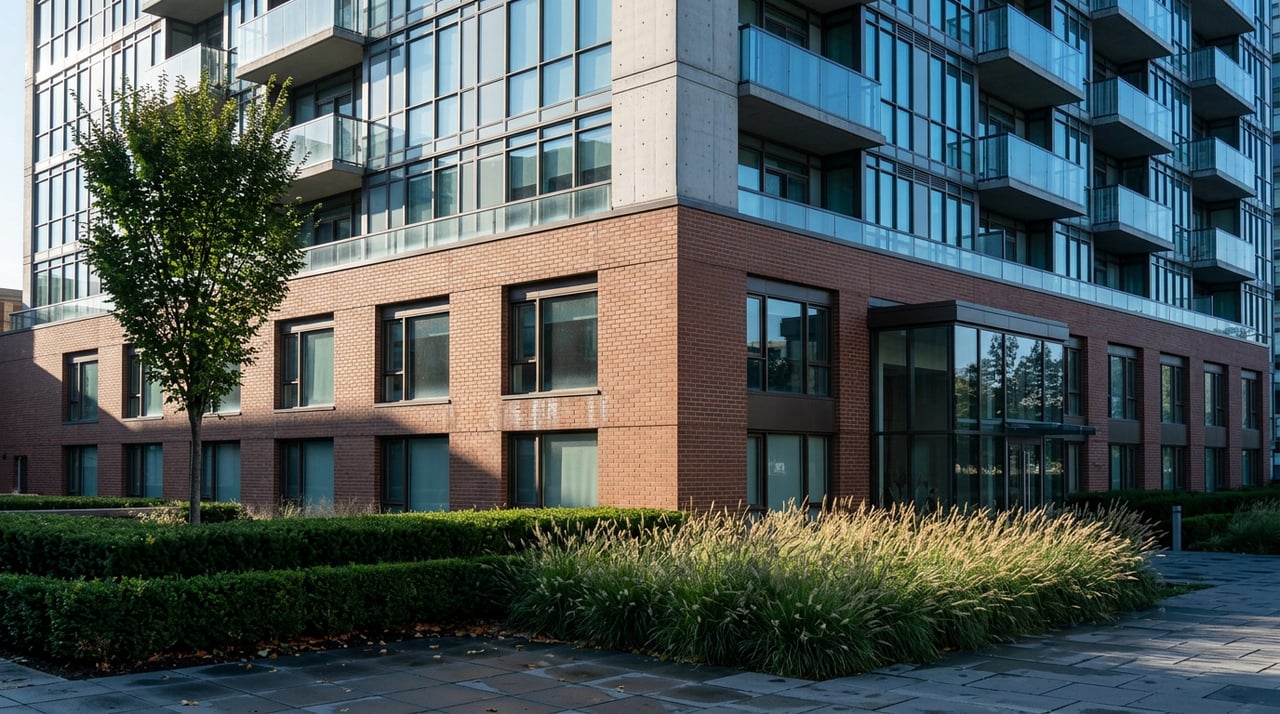
The Hudson Tea Building, the converted 1916 Lipton Tea factory at 1500 Washington and 1500 Hudson Street, is a concrete and masonry structure well past the 20-year threshold, meaning it sits inside the tighter five-year reinspection cycle. Maxwell Place, built by Toll Brothers City Living across four towers between 2006 and 2021, is newer podium construction that also qualifies as a covered building, but on a different inspection clock depending on when each individual tower was completed. Neither building's inclusion under the law tells you anything about its financial health. It only tells you that a structural inspection and a funded reserve plan are now mandatory rather than optional, which is precisely why the reserve study itself, not the building's reputation or its age, is the document worth reading.
| Building type in Hoboken | Structural inspection trigger | What a buyer should request |
|---|---|---|
| Pre-2005 industrial conversions (concrete or masonry) | Reinspection within 5 years once past 20 years old | Most recent engineer's report and reserve study |
| 2006 to 2019 podium construction | Standard inspection cycle, tightening as buildings age | Reserve study funding percentage (100% vs. 85% option) |
| 2020 to present construction | Newest to the inspection cycle, still legally covered | Board's initial reserve study timeline and baseline plan |
| Wood-frame low-rise and rowhouse conversions | Generally excluded from structural inspection mandate | Reserve study still required if condo-structured |
New Jersey's attorney review period is the window where this information actually becomes useful, not after the contract is signed. The documents worth requesting through that process are consistent across every credible reserve-law guide:
None of these documents require a lawsuit or a subpoena. They are the ordinary paperwork of buying into a shared building, and under the current law, most of them are supposed to exist whether a buyer asks or not.
Does this law apply to Hoboken's classic brownstone conversions? Only if the building's structure is concrete or masonry and it's organized as a condominium. A small two- or three-unit brownstone conversion with a wood-frame structure generally falls outside the structural inspection mandate, though the separate reserve study requirement can still apply if the association is condo-structured and holds shared capital assets.
Can a pending reserve issue actually delay or derail a closing? It can complicate financing more than it delays the closing date itself. If a lender's condo questionnaire flags an underfunded reserve or an association at 85 percent funding, underwriting can require additional documentation or, in some cases, push the loan to a different program entirely. Catching this during attorney review, rather than during underwriting, is what keeps a timeline intact.
Does a higher HOA fee always mean a safer building? Not automatically. A higher fee paired with a fully funded reserve study is a strong signal. A higher fee that still doesn't match the reserve study's recommended funding level is a warning sign of its own. The fee is a data point. The reserve study is the answer.
Every Hoboken waterfront building carries its own version of this story, and the only way to read it accurately is to know which era it was built in, what its last structural inspection actually found, and how its board chose to respond to a law that gives buyers more paperwork to ask for than they had two years ago. That is precisely the kind of building-by-building knowledge that separates a confident offer from a costly guess.
If you're weighing a purchase or a sale on Hoboken's waterfront and want a straight read on what a specific building's reserve position actually means for you, Jessica Williams is glad to walk through it. Contact Jessica for a private consultation.
Stay up to date on the latest real estate trends.


Jessica builds trust with each and every client, making their interests the central focus of each and every transaction. This loyalty is often rewarded through repeat clients and extensive referrals, creating an ever-growing network of high-profile clientele with very similar real estate needs. Contact her today!