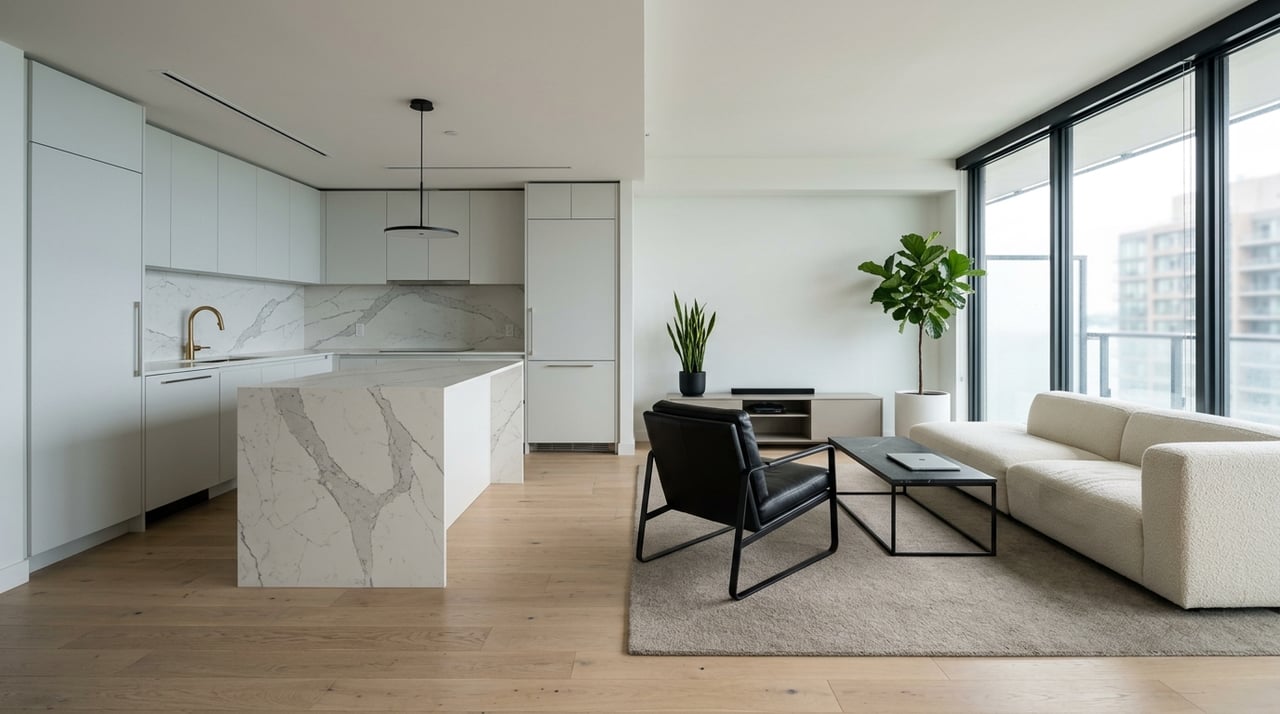
Understanding Monthly Costs For Hoboken Condo Owners
May 14, 2026
May 14, 2026
Wondering why one Hoboken condo carries a few hundred dollars in monthly ownership costs while another can feel dramatically higher? If you are comparing buildings, planning a purchase, or refining your budget, that question matters more than most buyers expect. The good news is that once you break the numbers into clear categories, monthly condo costs become much easier to evaluate with confidence. Let’s dive in.
For most Hoboken condo owners, the main non-tax monthly costs fall into four buckets: association fees, utilities, parking, and smaller unit-level upkeep. The exact mix depends on the building, the services included, and how much is bundled into your monthly dues.
That last point is especially important. A condo with a higher monthly fee is not always more expensive to own if that fee already covers items you would otherwise pay separately, such as water, sewer, hot water, trash, or even cooking gas.
In Hoboken, condo association fees are often the largest recurring cost after your mortgage. Under New Jersey’s Condominium Act, common expenses are allocated under the master deed and bylaws, and the association is responsible for the maintenance, repair, replacement, cleaning, and sanitation of common elements.
The New Jersey Department of Community Affairs notes that common areas can include spaces and systems such as hallways, basements, roofs, pools, parking lots, and lawns. In practical terms, your monthly dues help support the shared parts of the property that all owners rely on.
Recent Hoboken listing examples show a very wide range in monthly dues. Examples in current or recent listings include $319, $398, $618, $625, $881, $1,305, $1,527, $1,789, and as high as $2,773 per month.
Those figures are not formal market averages, but they do show how broad the spread can be from one building to another. In most cases, the difference comes down to building service level, amenity package, age and infrastructure, and what is bundled into the fee.
Based on current listing examples, a useful budgeting framework looks like this:
This is a practical inference from active and recent listing examples, not a formal market-wide average. Still, it gives you a realistic starting point when you begin comparing Hoboken buildings.
One of the smartest ways to evaluate a condo is to ask not only, “What is the monthly fee?” but also, “What does that fee already cover?” In Hoboken, listings show that included items can vary quite a bit.
For example, one listing noted that the HOA fee included cooking gas, water and hot water, trash, and sewer. Another stated that flood insurance, common area maintenance, trash, and recycling were included. Another included water, sewer, snow removal, trash, pool access, reserve funds, management, insurance, custodial services, maintenance, and common area maintenance.
When you review a condo’s monthly cost structure, ask for clarity on whether the HOA includes:
These details matter because two condos with similar sticker prices can carry very different ownership costs month to month.
Utilities are the next major piece of the puzzle. Hoboken’s official infrastructure information identifies PSE&G as the electric and natural gas utility.
Electricity is often the most visible separate utility for condo owners. PSE&G’s current notices use examples that range from an $81.85 bill for a 342-kWh average month to a $158.15 bill tied to a 558-kWh average month and a 683-kWh summer month.
For many Hoboken condos, electricity often lands somewhere from the low $80s to the mid $150s per month. Your actual bill will depend on factors like unit size, time of year, and whether your heating or cooling is electric.
That means two similar-looking condos may still produce different utility bills. A larger home with more glazing, stronger summer cooling demand, or electric heat may cost more to run than a compact residence with more utilities bundled into the building fee.
Gas costs can be modest or more noticeable depending on the unit and what the building includes. PSE&G’s current example bills range from $27.51 at 16 therms to $178.08 at 152 therms, with several examples in between.
If your building includes cooking gas or hot water in the HOA dues, your separate gas bill may be much smaller or, in some cases, effectively nonexistent. That is one more reason bundled services deserve careful attention when you compare condos.
Water and sewer charges are often underestimated by buyers because they are not always billed the same way from building to building. Hoboken’s water system is city-owned and operated by Veolia, while the North Hudson Sewerage Authority handles sewer and stormwater.
According to current local charges, the North Hudson Sewerage Authority residential wastewater rate is $10.55 per 1,000 gallons, with a $63.30 quarterly minimum for the first 6,000 gallons, plus a $20.16 quarterly service-unit charge. On a monthly equivalent basis, that works out to about $28 at minimum usage, around $49 at 12,000 gallons per quarter, and about $70 at 18,000 gallons per quarter.
If water and sewer are included in the HOA, you may never feel these costs as separate line items. If they are not included, they should be part of your monthly ownership math.
This is where buyers can get tripped up. A condo with lower dues may look better at first glance, but if it leaves more utilities outside the HOA, the real monthly cost can be closer to a unit with higher dues and more bundled services.
Parking is another major variable in Hoboken, especially if you own a car and are deciding between on-street and off-street options. Depending on the building, parking may be included, available for an added fee, or completely separate from the condo purchase.
For residents using city permits, Hoboken’s official on-street parking permit costs are relatively modest. The first vehicle is $61 per year, the second is $122, and the third and each additional vehicle are $243. Seniors, veterans, and disabled residents qualify for a $28 annual permit.
Broken into monthly terms, that works out to roughly:
These figures can help if you are deciding whether street parking is workable for your lifestyle.
For buyers who prefer the convenience of a garage or deeded spot, monthly parking costs can be much more significant. Hoboken operates four municipal garages and offers monthly parking, but rates vary by garage and permit type.
Current market listing examples show Hoboken monthly parking averaging about $312, while featured monthly rates on parking platforms have shown $250 to $300 at several garages, including a $300 spot at 1125 Maxwell Lane. If your building does not include parking, this line item can meaningfully affect your total monthly cost.
When you compare properties, focus on the total monthly ownership picture, not just one number. The cleanest way to do that is to build a side-by-side estimate using the same categories for each condo.
Here is a helpful checklist:
Once you total those categories, you will have a much more accurate view of what living in each condo may feel like month to month.
In Hoboken, higher-end and waterfront buildings often carry higher monthly dues because they tend to offer more services, more staffing, more amenities, and more extensive building systems. That does not automatically make them a worse value.
In fact, for many buyers, those buildings can offer a more predictable ownership experience because more services are centralized and managed through the association. The key is making sure the fee level matches the building’s services, condition, and your own priorities.
If you take one idea from this guide, let it be this: the monthly fee alone never tells the full story. The better question is what your payment covers and what still remains outside of it.
That is where an experienced, building-specific review can save you time and help you avoid budget surprises. In Hoboken, especially across luxury and waterfront inventory, the monthly cost structure can vary meaningfully from one address to the next.
If you want help comparing monthly ownership costs across Hoboken condos, Jessica Williams offers a polished, hands-on approach with deep local insight into waterfront buildings, amenities, and real monthly budgeting.
Stay up to date on the latest real estate trends.


Weehawken, NJ
Living on the Weehawken Waterfront

Jessica builds trust with each and every client, making their interests the central focus of each and every transaction. This loyalty is often rewarded through repeat clients and extensive referrals, creating an ever-growing network of high-profile clientele with very similar real estate needs. Contact her today!