Grand Street Gets Its Parking Back and Keeps Its Corners
November 12, 2026
November 12, 2026
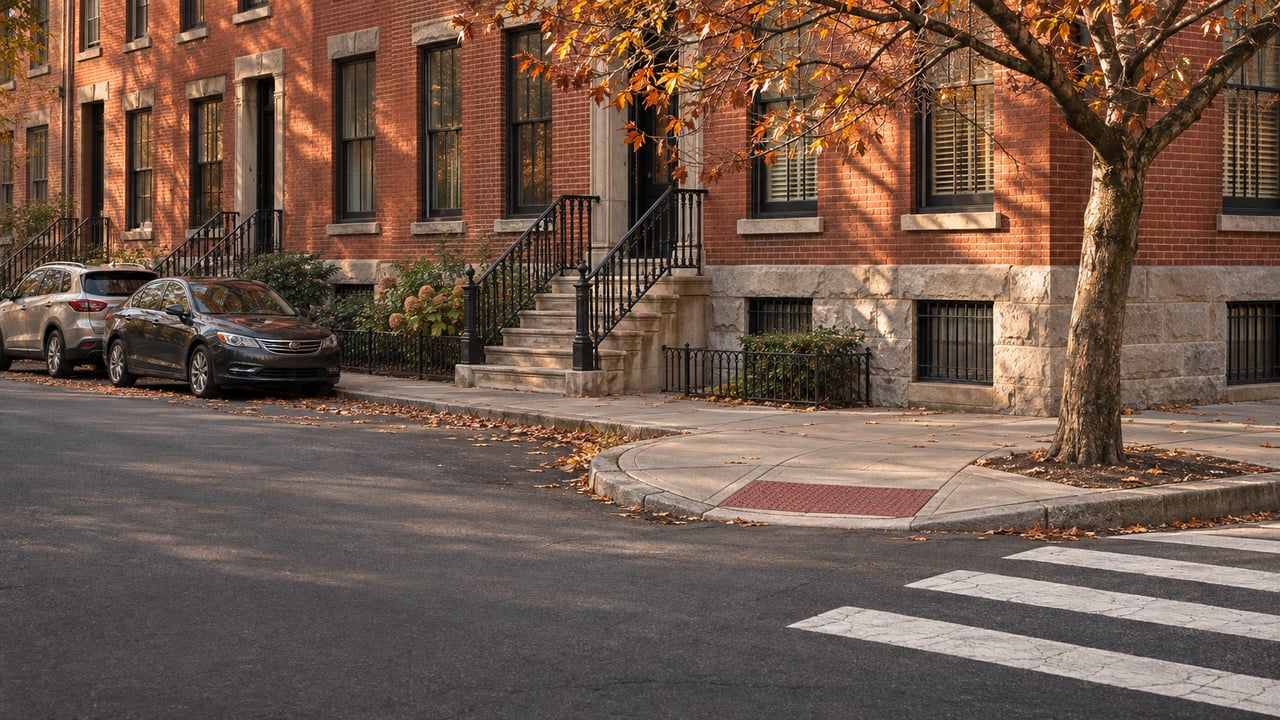
For a year, the east side of Grand Street between Third and Eighth Streets has had parked cars sitting away from the curb, with a bike lane tucked between them and the sidewalk. At the corners, painted curb extensions pull the crosswalks in. The project added 23 high-visibility crosswalks, 11 curb extensions, all-way stops at three intersections and 36 bike parking spaces. Construction started in October 2025, and the last pieces went in before the project was substantially complete in June 2026.
Only part of that layout is leaving. On November 6, the City of Hoboken announced an updated plan that takes out the protected bike lane and the individually marked parking stalls. The pedestrian work at the intersections stays. The corners keep the pilot's design, and the curb between them goes back to roughly how it was before. How well the street works now depends less on new paint and more on whether drivers and delivery trucks have a legal place to stop.
The pilot began underground. In the city's own account to the City Council, Transportation and Parking Director Ryan Sharp explained that Grand Street's water mains, about 100 years old, were replaced largely during 2023 as part of Water Infrastructure Upgrades Phase Two. Repaving was the second phase. Under Hoboken's Complete Streets policy, any milling and paving job is supposed to add safety and accessibility improvements where it can, Hudson County View reported.
The city's evaluation says the design came from a white paper by Third Ward Councilman Michael Russo. It tested individually striped parking spaces, a bike lane protected by parked cars, and bike parking in the clear zones at intersections. Leftover punch-list work picked up again in spring 2026, and the project was substantially complete in June 2026, once the painted curb extensions and bike corrals were in. The design was meant to run for one year starting in November 2025, but residents lived with the finished version for only about five months.
On August 12, the council passed a nonbinding 7–2 resolution asking to end the pilot early. Councilman at-Large Joe Quintero and Fifth Ward Councilman Phil Cohen voted no, according to Hoboken Girl. Mayor Emily Jabbour let the pilot run its full year.
The evaluation compared Grand Street before and during the pilot on several measures. Survey respondents described a different street from the one the counters recorded.
| What staff measured | What survey respondents reported |
|---|---|
| The 30-day average crash rate fell 43%, from 0.89 to 0.51 | 58% did not support keeping the protected bike lane |
| Crashes involving sideswiping or hitting a parked vehicle fell 57%, from 0.71 to 0.31 per 30 days | 49% did not support keeping the marked parking stalls |
| Field observers counted zero double-parking events during the pilot | 46% said double parking got worse |
| Commercial vehicle crashes went from eight to zero | 57% said emergency and truck access got worse |
| Citi Bike trips through the pilot area rose 53% | 64% of people who rode the protected lane said they felt safer in it |
The survey drew nearly 1,300 responses. At the council's Wednesday meeting that week, staff said 98% of respondents lived in Hoboken and a quarter of those lived on Grand Street. Among Grand Street residents, 73% opposed keeping the lane. The department's deputy director told the council that both sets of results could be true. In his words, the survey captured "how the street felt for people especially as people were adjusting to the changes," while the counts could miss near misses, unreported incidents, or trucks that stopped using the street altogether, Hudson County View reported.
Parking was the one cost both sides accepted. The evaluation estimates 146 spaces before the pilot and 126 with the marked stalls, a loss of about 20 spaces, or 14%. That comparison sets parked cars counted in September 2025 against marked spaces counted in October 2026.
The new plan splits the street in two. Most of the pilot's measured gains came from work at the intersections, and that work stays. Parking space was lost along the curb, and that is what changes.
Staying in place:
Going back to the old layout:
The evaluation also cites cost as a reason to keep the corners. Leaving the painted extensions in place avoids the asphalt damage that comes with grinding off the existing Endurablend surface treatment.
Mayor Jabbour described the plan as a hybrid in the city's announcement:
"This hybrid approach preserves important pedestrian protections, provides bicycle protection within existing daylit approaches, and restores approximately 20 parking spaces."
When the protected lane comes out, the street gets one less layer of separation. The evaluation's recommendations warn that "a 17-foot clear right-of-way between parking zones will encourage double parking," which can block emergency, transit and commercial vehicles.
To keep that from happening, the evaluation calls for focused enforcement against cars parked in crosswalks, hydrant zones, driveways, intersection clear zones, bike lanes, travel lanes and loading zones. It also proposes daytime "flex zones" for deliveries and passenger pick-up and drop-off that switch to permit parking overnight, following the city's draft Curb Reimagined plan. In the survey, 64% of respondents said legal loading space was insufficient, and 76% of residents on the affected blocks said the same. Of all respondents, 46% supported the daytime-loading, overnight-parking idea.
The corridor already had to work out some of these problems during the pilot. The evaluation lists the adjustments: added turning clearance for trucks serving ACME, a temporary loading zone for Otok Bakery, a wider driveway at Willie McBride's, and the removal of Amazon's all-day delivery hub at 15 Church Towers. The council adopted loading-zone changes on March 11, 2026. On the 500 block, which was the only block in the pilot area with designated loading zones, observers had counted two of the three pre-pilot double-parking events.
Street sweeping shows how one change affects others. With parking floated away from the curb, the city ran 60 sweeper passes on the protected-lane side between November 2025 and October 2026, compared with 52 in a typical year. Once cars park against the curb again, sweepers can't reach it unless those cars move. That is why the weekly east-side restrictions are coming back, and the evaluation expects them to increase parking turnover. For anyone who parks on the east side of Grand Street, the restored sweeping schedule is the change most likely to show up in their week.
According to Sharp's answer to Second Ward Councilwoman Tiffanie Fisher, the Class II lane is what the existing ordinance already requires, and street sweeping is already in the code too. That means neither change needs a council vote. The city does have to hire a contractor to restripe the street, Hudson County View reported. The schedule so far:
The talks about protected bike lanes now move to the rest of the city. The city says its next step is a community process to choose locations for a network of protected lanes. Meanwhile the Green Circuit, a protected bikeway around the city's perimeter, is under construction, Sharp told the council, according to Hudson County View. Councilman Quintero argued that the survey was "one data point of six or seven other data points" and that the full set showed "the street is generally safer." The final evaluation is available as the Grand Street Pilot Evaluation report, with the block-level detail behind every number above.
Parking, loading and street sweeping all shape everyday life on a Hoboken block, and they affect how a home there lives day to day. If you own on Grand Street or nearby and want to talk through what the new curb rules mean for your building, Jessica Williams is glad to help. Contact Jessica for a private consultation.
Stay up to date on the latest real estate trends.

Jessica builds trust with each and every client, making their interests the central focus of each and every transaction. This loyalty is often rewarded through repeat clients and extensive referrals, creating an ever-growing network of high-profile clientele with very similar real estate needs. Contact her today!